How to Size a Water Softener: The Complete Guide + Free Calculator
Affiliate Disclosure: This guide contains affiliate links. We may earn a commission at no extra cost to you.
Water Softener Size Calculator
The Sizing Formula Explained
Every water softener has a grain capacity - the total amount of hardness minerals (calcium + magnesium) it can remove before it needs to regenerate. Buying the wrong size is the #1 mistake homeowners make.
The formula is straightforward:
Minimum System Size = Daily Grain Requirement × Desired Days Between Regeneration
Example: A family of 4 with 20 GPG water, wanting 7-day regeneration intervals:
- Daily: 4 × 75 × 20 = 6,000 grains/day
- 7-day system: 6,000 × 7 = 42,000 grain minimum capacity
- Recommendation: 48,000-grain system (next size up for margin)
How to Find Your Water Hardness
Option 1: Water Utility Report (City Water)
If you're on municipal water, your utility publishes an annual Water Quality Report (Consumer Confidence Report). Search "[your city] water quality report" or look at the utility's website. Hardness is usually reported in mg/L or ppm - divide by 17.1 to convert to GPG.
Option 2: Water Test Kit (Well Water)
A simple water hardness test strip or drop kit costs $8–$20 on Amazon. Test your water at the cold water tap nearest your main line for the most accurate reading.
Option 3: Culligan or Local Dealer
Most dealers offer free in-home water testing. Useful if you want a comprehensive profile (hardness, iron, pH, TDS).
| Hardness Level | GPG Range | Impact | Softener Needed? |
|---|---|---|---|
| Soft | 0–3 GPG | Minimal | No |
| Slightly Hard | 3–7 GPG | Mild spotting | Optional |
| Moderately Hard | 7–10 GPG | Scale on fixtures | Recommended |
| Hard | 10–25 GPG | Significant scale, soap issues | Yes |
| Very Hard | 25–50 GPG | Severe scale, appliance damage | Strongly recommended |
| Extremely Hard | 50+ GPG | Rapid pipe/appliance damage | Essential |
Common Household Sizing Guide
| Household Size | Water Hardness | Recommended Size | Best System |
|---|---|---|---|
| 1–2 people | Up to 25 GPG | 24,000–32,000 grain | Fleck 5600SXT 24K |
| 2–4 people | Up to 20 GPG | 32,000 grain | SpringWell 32K |
| 3–5 people | 20–35 GPG | 48,000 grain | SpringWell 48K |
| 4–6 people | 35–50 GPG | 64,000 grain | SpringWell 48K–80K |
| 6+ people or well water | Any | 80,000+ grain | SpringWell 80K |
Don't Forget Iron
If your well water contains iron (common in many US regions), you need to add it to your hardness calculation. Multiply your iron content in PPM by 4 and add it to your GPG hardness number for sizing purposes.
Example: 20 GPG hardness + 3 PPM iron → 20 + (3 × 4) = 32 GPG effective hardness for sizing.
SpringWell's SS system handles up to 7 PPM iron natively, which covers most well water scenarios. Above 7 PPM, consider adding a dedicated iron filter (like the SpringWell WS) upstream of the softener.
Our Top Picks by Size
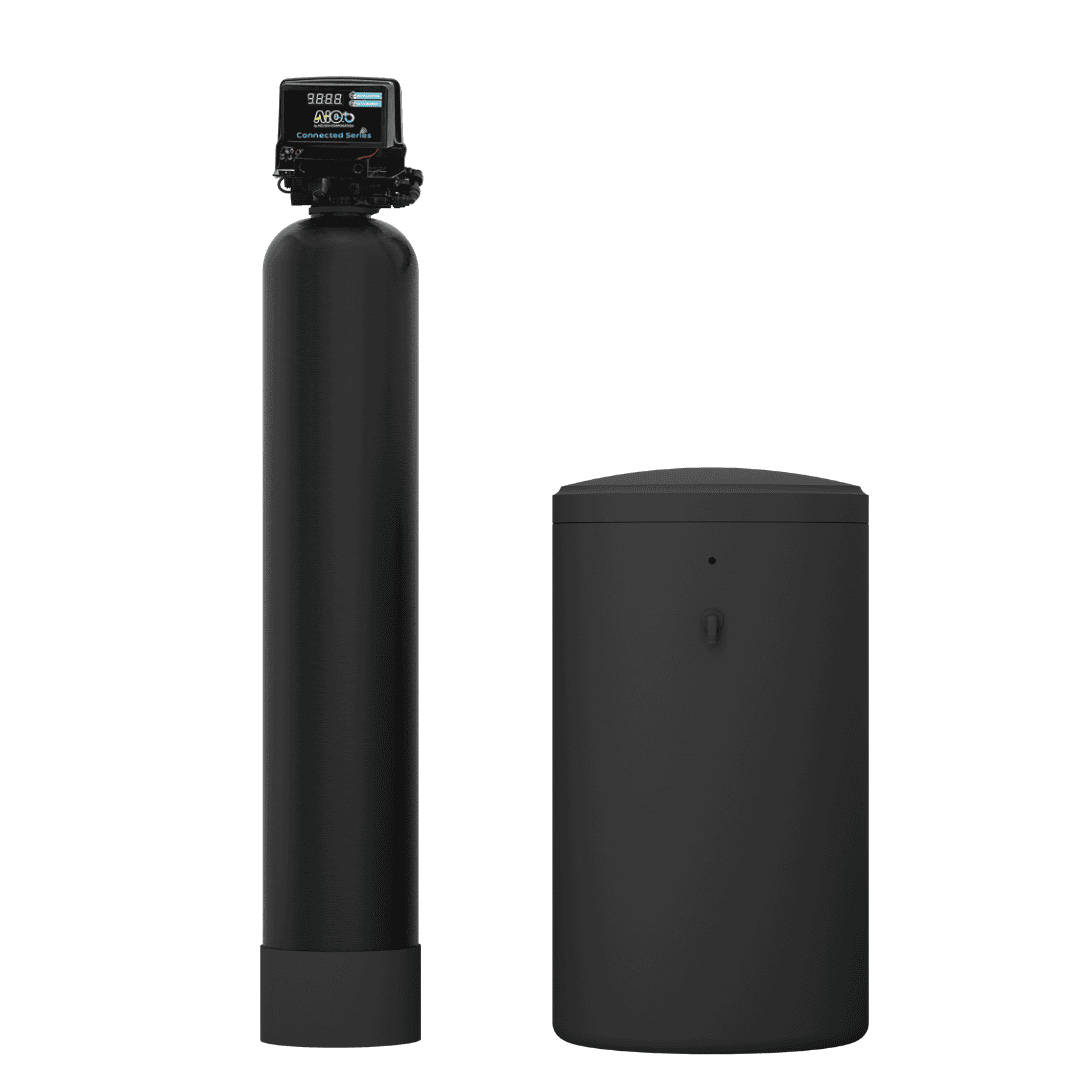
SpringWell SS 32K
Covers 1–3 bathrooms, up to 4 people, hardness up to 25 GPG. Lifetime warranty, 11 GPM flow rate.
SpringWell SS 48K
Covers 4–6 bathrooms, up to 6 people, hardness up to 35 GPG. 13 GPM flow rate.
Real Sizing Scenarios: What Homeowners Actually Need
Abstract formulas are useful, but real decisions happen in specific situations. Here are the most common scenarios and what sizing makes sense for each.
Scenario 1: Suburban Family, City Water, Moderate Hardness
Profile: 4 people, city water, hardness 13 GPG (near US average), no iron. Daily grain demand: 4 x 75 x 13 = 3,900 grains/day. For a 7-day cycle: 27,300 grains needed. A 32,000-grain system is the right call -- it regenerates every 8.2 days, which is within the ideal window. SpringWell SS1 (32,000 grain) fits this exactly.
Scenario 2: Southwest Home, Very Hard Water
Profile: 3 people, city water, hardness 30 GPG (Phoenix/Las Vegas range), no iron. Daily grain demand: 3 x 75 x 30 = 6,750 grains/day. For a 7-day cycle: 47,250 grains needed. A 48,000-grain system hits the target. For extra margin in a very hard water area, the 64,000-grain system is worth the upgrade cost.
Scenario 3: Well Water with Iron
Profile: 5 people, well water, hardness 18 GPG, iron 3 PPM. Adjusted hardness: 18 + (3 x 5) = 33 GPG equivalent. Daily grain demand: 5 x 75 x 33 = 12,375 grains/day. For a 7-day cycle: 86,625 grains. This household needs an 80,000+ grain system, and should add an iron pre-filter upstream of the softener. This is a situation where undersizing is especially costly -- iron fouls resin aggressively.
Scenario 4: Empty Nesters, Soft City Water
Profile: 2 people, city water, hardness 8 GPG. Daily grain demand: 2 x 75 x 8 = 1,200 grains/day. For a 7-day cycle: 8,400 grains. A 24,000-grain system regenerates every 20 days -- too infrequent. A 16,000-grain system regenerates every 13 days, which is acceptable. This is one case where buying the smallest available system (often 24K) and adjusting the regeneration frequency to every 2 weeks is the right approach.
Common Sizing Mistakes (And How to Avoid Them)
Water softener sizing errors are extremely common, and they cost homeowners money in two ways: either the system is too small and cannot keep up with demand, or it is too large and regenerates so infrequently that the resin fouls between cycles. Both problems are avoidable.
Mistake 1: Using Household Size Alone
Many online sizing calculators ask only how many people live in your home. This misses half the equation. A family of 4 in Atlanta (average 5 GPG hardness) needs a 20,000-grain system. The same family in Phoenix (average 24 GPG) needs a 48,000-grain system. Hardness level matters as much as household size -- always factor both.
Mistake 2: Ignoring Iron
Iron is the silent saboteur of undersized softeners. Each part per million (PPM) of iron in your water is roughly equivalent to 5 GPG of hardness in terms of resin demand. If your water test shows 2 PPM iron and 15 GPG hardness, treat it as 25 GPG when sizing. Failing to account for iron leads to a system that regenerates too frequently, burns through salt, and degrades the resin faster than expected.
Mistake 3: Oversizing Significantly
Bigger is not always better. A 64,000-grain system for a family of 3 with moderate hardness will regenerate every 14-21 days. During that interval, the resin sits in contact with the hard water minerals it has removed, and without regular brine flushing, iron and organic matter can foul the resin. Target a system that regenerates every 7-10 days under normal usage. Going one step up for safety margin is reasonable; two steps up creates problems.
Mistake 4: Forgetting Peak Flow Rate
Grain capacity tells you how much hardness the system can remove before regenerating. Flow rate (measured in gallons per minute, GPM) tells you whether the system can keep up with your household's simultaneous demand. A 3-bathroom home running a shower, dishwasher, and washing machine simultaneously needs at least 12-15 GPM. Check the flow rate spec, not just the grain capacity, when comparing systems.
Mistake 5: Not Accounting for Water Softener Bypass
Most whole-house softeners include a bypass valve. Many homeowners install an unsoftened line to outdoor irrigation -- there is no benefit to softening irrigation water, and it wastes salt. Plan your plumbing layout before installation to ensure the softener only treats indoor water. This reduces salt consumption by 15-30% in homes with significant irrigation use.
Flow Rate: The Spec Most Buyers Overlook
While grain capacity gets most of the attention in water softener reviews, flow rate is equally important for household comfort. Low flow rate creates the most common complaint among softener owners: "My water pressure dropped after installing the softener."
| Home Size | Bathrooms | Minimum GPM | Recommended GPM |
|---|---|---|---|
| Small (1-2 people) | 1-2 | 8 GPM | 10 GPM |
| Medium (3-4 people) | 2-3 | 10 GPM | 12-15 GPM |
| Large (5+ people) | 3-4 | 12 GPM | 15-20 GPM |
| Large with irrigation | 3+ | 15 GPM | 20+ GPM |
SpringWell's SS series stands out here -- even the entry-level SS1 delivers 11 GPM, while the SS4 reaches 20 GPM for large homes. Many competing systems top out at 8-10 GPM, which creates noticeable pressure drop when multiple fixtures run simultaneously.
Sizing FAQ
Is bigger always better for grain capacity?
Not necessarily. Oversized softeners regenerate less frequently, which means the resin can foul with iron and organic matter between cycles. Target 7-day regeneration intervals. Going 1 size larger for margin is fine; going 2+ sizes up can cause more harm than good.
What if I don't know my water hardness?
Buy a test kit ($8–$15 on Amazon) - it's the most accurate method. Alternatively, call your city water utility and request your annual water quality report. You can also check the USGS water hardness map for your region. The average US municipal water hardness is about 13 GPG, but regional variation is extreme (Nevada averages 30+ GPG; Atlanta averages under 5 GPG).
Should I size up if I plan to add bathrooms or people?
Yes. If you are planning a home addition or expecting household growth within 5 years, size up one step. The incremental cost is usually $150-$400 and far cheaper than replacing a system early.
How do I calculate grains per day to size my softener?
The formula is: (number of people) x (gallons used per person per day) x (water hardness in GPG) = grains per day. For a family of 4 using 80 gallons per person per day with 20 GPG hardness: 4 x 80 x 20 = 6,400 grains per day. A 48,000-grain softener regenerates every 7.5 days (48,000 divided by 6,400). That is a healthy interval. If iron is present, add 5 GPG per PPM of iron to your hardness number before calculating.
Does softener size affect salt efficiency?
Yes, in two ways. First, larger systems use more salt per regeneration cycle simply because there is more resin to recharge. Second, systems that regenerate too infrequently (oversized for the application) may need to use more salt per cycle to fully clean fouled resin. The most salt-efficient setup is a properly sized system with demand-initiated regeneration (DIR) that regenerates only when the resin is actually depleted, not on a fixed timer. All modern SpringWell systems use DIR.
What happens if my water softener is too small?
An undersized softener exhausts its resin capacity before the next scheduled regeneration cycle, allowing hard water to pass through to your home -- called "hardness breakthrough." You will notice scale and soap lathering problems returning between regeneration cycles. The fix is either to increase the regeneration frequency (using more salt) or to replace the system with a properly sized one. This is why buying a system with a 6-month money-back guarantee (like SpringWell offers) matters -- if the sizing calculation is wrong, you have a path to correct it without losing your investment.